Published
Review
Going for a Summer Look in Winter
The camera, the lenses, the light and the model
In winter, the light noticeably fades. The days grow shorter, the sky is more often heavy, and the sun never climbs very high. And yet what looks like a drawback hides a gift: all day long, the low sun gives the warm, raking light that in summer lasts barely an hour before sunset. So the question is not whether we can shoot in winter, but how to keep the summer look: the warm tones, the brightness, the feel of air and sun, when it's cold outside. And the answer starts with the tool.
One camera, medium format. The Hasselblad 6×6 is the traditional eye of film, with the square frame that defined the aesthetic of generations of fashion photographers. On the other hand, today's digital medium-format sensors now reach staggering megapixel counts, with exceptional sharpness and ISO flexibility that helps when the light drops. Both paths are valid. But the secret, if we want the warmth of summer to stay in the image, is to stay with film.
Our choice is the Pentax 6×7. Its frame, roughly 56×70 mm, is larger than the 6×6 square and, being rectangular, gives more information along the horizontal axis. With it comes the excellent range of Takumar lenses, the best known being the 105mm f/2.4, one of the fastest lenses ever made for medium format. A fast aperture is invaluable in winter: it lets more light reach the film, makes focusing easier and gives shallow depth of field when we want the subject to stand out. And Pentax took care of contrast: the Super-Multi-Coated (SMC) coating of its lenses increases contrast and reduces flare, which is crucial when the low winter sun strikes almost straight into the lens. The image thus keeps its sharpness and punch, without sacrificing rich luminosity when we want it.
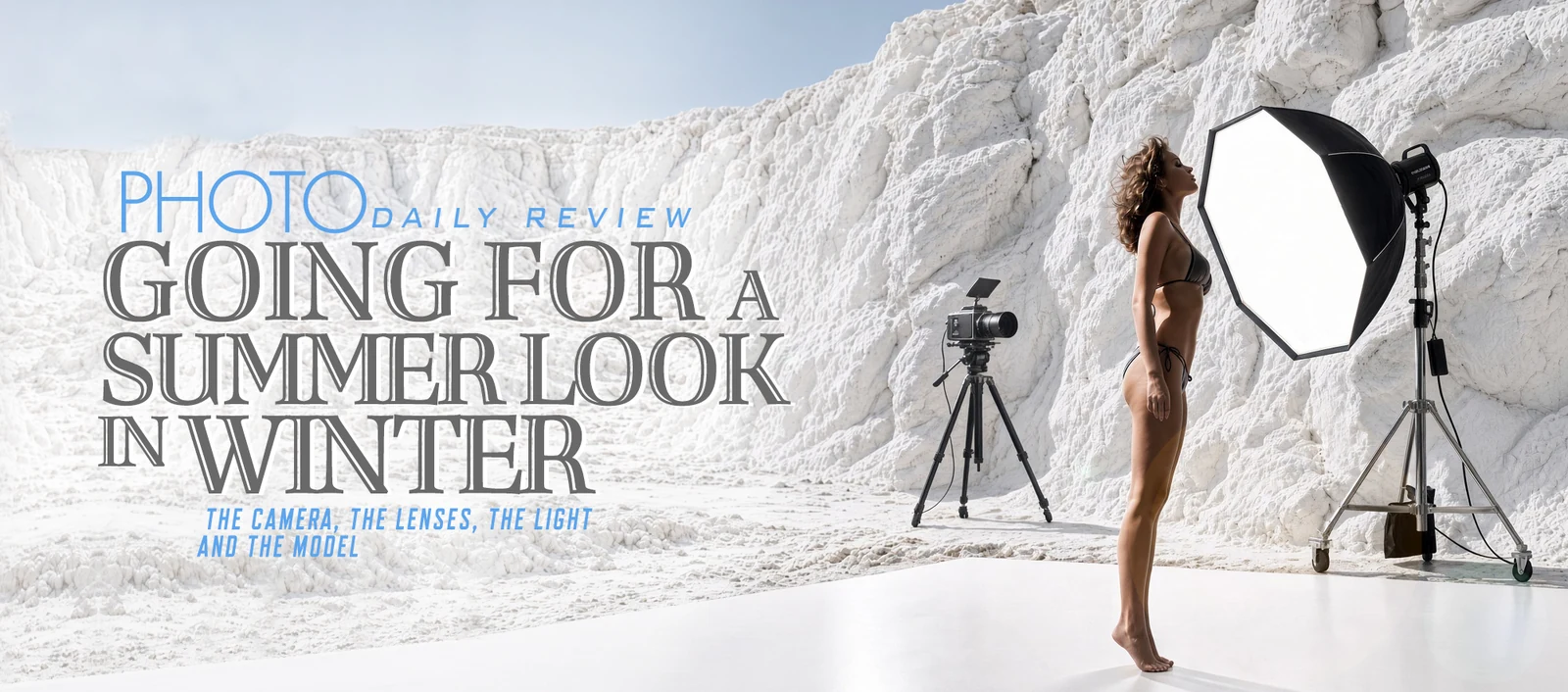
But we also need artificial light. When the sun is not enough, we create it: a battery-powered studio flash and a large octabox become our own summer sun, even outdoors. On a real shoot we need powerful flash units and large umbrellas, ideally with some continuous lights as well, that throw plenty of light over a large area and can hold their own against daylight. Outdoors, every stand needs sandbags, because in the Aegean wind an umbrella easily turns into a sail. When it comes to filming, however, flash is of no use, because a moving image needs continuous light. That is where HMIs come in: powerful daylight-balanced lamps that match the sun and can replace or boost it. They do require planning: a generator outdoors, an experienced crew and care with the heat they give off. The large softbox gives soft, wrapping light, while for the hard, clean shadow of the August midday sun a small reflector or a bare flash is enough. We place the source low and to the side, the way the sun falls on a summer afternoon, and with an orange gel (CTO) or a gold reflector we add the warmth the winter sky lacks. One technical detail matters a great deal: the Pentax 6×7's focal-plane shutter syncs with flash at only 1/30 of a second, which in daylight easily leads to overexposure and "ghosting". The solution is the leaf-shutter (LS) lenses, such as the 90mm f/2.8 and the 165mm f/4, which sync at all speeds up to 1/500 and let us balance flash with ambient light.
The scale of the shoot determines the crew: a director of photography, camera operator, lighting technicians and assistants as needed. On film, checking exposure and planning before each take matter especially.
Finally, the model needs special care. Winter is harsh, especially when posing in the cold in summer clothes. A warm garment that can be removed for the shot goes on as soon as the model is dressed. After hair and make-up, the model stays somewhere warm. Once rehearsals are complete, the model steps onto the mark for as little time as necessary and returns to warmth immediately. The crew checks the material before wrapping. If digital capture is also used, files are copied to two independent destinations and the copies verified; exposed film is stored and transported according to the manufacturer's guidance. The person's wellbeing comes before the final frame.
The rest is an aesthetic choice. A colour negative film such as Kodak Portra 400, with exposure tested for the desired brightness, can produce open, warm, airy tones. We shoot when the sun is low and the light rakes across the scene. At slow shutter speeds, a stable tripod and mirror lock-up help limit vibration. The result can feel like summer even when it is cold outside.